
Влияние Instagram на психическое здоровье в 2025 году
Envision a scenario where you arise from sleep, approach your cellular gadget, and at the flash of an eye, you are scrolling through an exhibition of a myriad of holiday photos, personal fitness accomplishments, and immaculate food pictures. This is merely another morning spent on Instagram. However, beneath those thumbs-up clicks and heart symbols lies a more in-depth connection between this image-based technology and our mental health.
With this over 2 billion active user base, Instagram has transitioned from being a simple platform for photographs, to becoming a cultural decider of how we perceive ourselves and those surrounding us. Especially for the youth and students, whom the development of social networks has taken along, deciphering this symbiosis is not just theoretical but emotional as well.
The Bright Filters: Positive Mental Health Impacts
Although there are commonly raised objections, Instagram has introduced foreseeable mental health advantages worthy of being recognized as follows:

- **Community building**: The townspeople, having rare conditions or specialized interests, find their tribes
- **Visibility for different voices**: The sidelined groups throw open the doors for free expression
- **Mental health awareness**: Social platforms use hashtags like #mentalhealthawareness that can cause stigma to distrust
- **Creative outlets**: Photography, art, and writing communities stimulate creativity.
Consider Alex, a college freshman who found it difficult to socialize because of his anxiety. With the words, “I met a group of folks who were just as drawed to these peculiar novels as I was. Eventually, the sense of belonging I found there was transferred to my life outside the internet. I got to hang out with my online friends in real life,” Alex summarized his experience.
Huber et al. (2020) confirm these observations. A 2023 research study conducted at Columbia University pinpointed the strategic social media usage—putting it simply: active participation in the supportive community—as an important factor, which increased the feeling of happiness and lessened the feeling of isolation in the youth.
The Dark Side: When Scrolling Takes A Toll
If we get honest with ourselves, Instagram may be one of the worst choices you can make for your mental health. The way it is designed can encourage users to act in certain ways, behaviors which many psychologists find to be distressing:
The Evil of Comparison
The human brain was unable to manage being confronted with 200 “perfect” lives within a couple of hours. However, this is the very thing we do by just scrolling down our Instagram feeds. Psychologists term this behavior as “upward social comparison”—measuring one’s worth against others who seem to be doing better.
The Stanford University study showed that undergraduate students invariably believed that social media posts reflected their peers’ happiness, although they underestimated how often their peers felt sad. This incongruity resulted in a feeling of inferiority.
“Peering into my classmates’ posts, where they are going to work after forging ahead in their studies, posted by interns, I observed and I said to myself that my career has no significance and I am on the wrong track even though I succeeded academically.” said Mia, a junior studying psychology. “But eventually, after chatting up those same people face to face, I understood they had problems—a situation that the social media avenue had a hand in making the same kids not post about it.”
The Economic Strategy: Its Outcome
Instagram isn’t crafted to help you heal; its primary purpose is to gain your focus. Its characteristics are the same as those of gambling habits:
- **Variable rewards**: You never know when you’ll get a like or comment
- **Pull-to-refresh**: The same mechanism as pulling a slot machine lever
- **Infinite scroll**: No natural stopping point
- **Notifications**: External triggers pulling you back in
These mechanics are designed specifically to exploit our brain’s reward pathways, causing our body to release dopamine. Many who were involved in the creation of social media have expressed remorse for the “addiction loops” that they pioneered.
Body Image Battlegrounds
Probably Instagram’s impact on body image has been the most widely researched mental health issue. The statistics include:
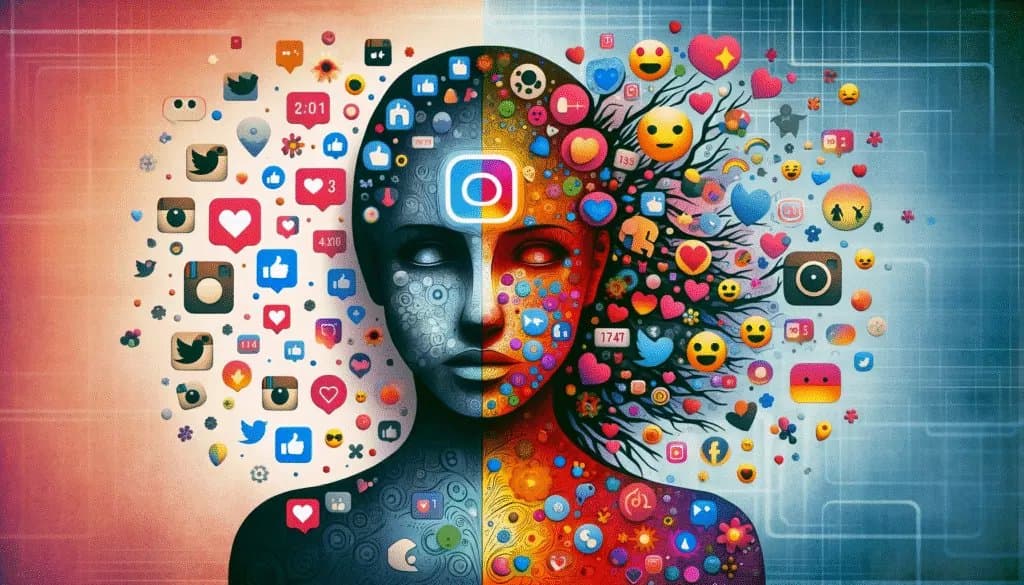
- 32% of teenage girls stated Instagram made them feel worse about their bodies (Facebook internal research)
- Engagement with accounts that emphasize appearance correlates with increased risk of disordered eating
- Higher body dissatisfaction is correlated with time spent editing photos and using filters
The trend of having an “Instagram face” which is a filtered and contoured look that is almost everywhere has entered a period of great interest in plastic surgery. In the world of cosmetic surgery, surgeons report that patients are bringing in their selfies produced with filters to point out the ideal results.
“I have had 16-year-olds come in requesting procedures that would bring them closer to their filtered photos,” Dr. Rachel Goldman, a famous plastic surgeon in Los Angeles tells us. “That was almost historical before social media.”
The Science of the Scroll
Our connection with Instagram goes beyond just habits—it quantifiably impacts our brains and bodies:
The Neurochemical Rollercoaster
When we use Instagram, the following critical mechanisms take place:
- **Dopamine pathways are disrupted** when we receive likes or make comments
- **Cortisol levels** the hormone of stress accelerate during unfavorable comparisons
- **Blue Light exposure** along with emotionally charged involvement leads to lost Sleep.
- **Post switching** at the express pace of the posts leads to brain entropy.
Studies that use brain scans proved that social media alerts are associated with the same brain regions that are activated when eating food and other major rewards. Hence, it is not surprising that a \”quick check\” often turns into 30 minutes of mindlessly scrolling.
The concept of FOMO which is the abbreviation of fear of missing out refers to the fear we are experiencing when disconnected. This twenty-first-century fear fosters the agonizing checking behavior that can distract from the task at hand, disturb the sleep cycle, and hurt face-to-face connections.
Checking that Balance: Healthier Instagram Habits
For many people, getting rid of Instagram altogether is not a viable option. Instead, scientific studies point to several strategies for healthier engagement:
Mindful Consumption Practices
A few small changes can improve your experience a lot:
- **Be strategic in your following**: Regularly assess whom you follow based on the emotional effect they cause you
- **Establish barriers of time setting**: Use app timers to limit daily use to 30 minutes or less
- **Practice the pause**: Before posting, reflect on \”why am I sharing this?\”
- **Create phone-free zones**: Designate spaces (bedroom) and times (meals) as Instagram-free
“Think of your feed as a garden,” suggests digital wellness coach Sam Lin. “You need to actively weed out what content does not contribute to your list of priorities. Be ruthless about it.”
Beyond Individual Actions
Although personal habits play an influential role, large-scale changes help, too:
- **Media literacy education**: Critical evaluation of images and messages
- **Platform accountability**: Users are pressurizing design changes that prioritize user well-being.
- **Open conversations**: Discussions about social media emotional consequences are normalized.
Schools have begun incorporating social media literacy into curricula such as teaching students to recognize filtered images, understand attention-capturing techniques and develop a healthy sense of digital boundaries.
Research Horizons: What We’re Still Learning
The field of research and pedagogy still, in the opinion of Many young people and researchers, are yet to achieve a very exciting level of research innovation and are still being exposed to questions that can stimulate the top quality of their thinking.
- How do different personality traits result in the forecast for the vulnerable feeling of somebody Instagram’s negative attributes?
- What characteristics of protection assist some users to maintain healthy relationships with this platform?
- How cultural characteristics influence the recognition of Instagram’s mental functioning?
- What future effects of the use of Instagram from childhood could arise?
In the future, longitudinal studies tracking social media use and mental health outcomes over years will provide valuable insights. Current research states communications are complex—effects depend on how, reasons, and when people use the platform.
The Authenticity Shift
Interestingly, Instagram culture seems to be changing. The curated image that was the king of these early years on the platform is being challenged by a community that seems to want more responsibility. “Photo dumps,” unfiltered images, and behind-the-scenes content illustrate this changing tide.
“Young people are more and more doubtful of online perfection,” says social media researcher Dr. Maya Hernandez. “They understand the negative effects of constant curation and are trying to be real.”
In fact, this change implies that users are modifying their behaviors as a defence against the platform’s dangers—a subject worthy of further investigation.
Taking Back Control
Instagram has a somewhat contradictory feel in our lives. Simultaneously, we connect and isolate, get inspiration and feel incapable, and gain power and feel exploited through it. Its overall effect on mental health is not counterproductive but rather polarizes and takes the most immense expression in our digital lives based on our interaction with it.
The essential understanding is probably this: You have more role than you realize. Although Instagram’s designers have made the tools for capturing enormous attention of, your final choice is still on who to follow, how long to stay online, and how much credence to give what you see.
Sherry Turkle, a researcher, says: “Technology invites us to a certain kind of relationship, but we can decline or accept that invitation.”
The best advice may be to treat Instagram the same way the potent tools were treated before with some caution for their potential, knowledge about their risks, and clear-cut regulation of their role in our lives. Your psychological well-being is how you can value yourself, not how much attention you have and therefore, your follower count.
In the course of your next scrolling session, if you ever feel the desire to make comparisons, please keep in mind that every seemingly flawless post that you come across is merely the direct opposite of the person who posted it, who only chose the best 30 seconds out of a mundane day like the rest of us. This notion could probably be the one that triggers the wise scroll actions of all of us.
Вопросы и ответы
Как Instagram влияет на психическое здоровье молодежи?
Instagram может влиять на психическое здоровье молодежи, заставляя ее соответствовать и вызывая чувство неадекватности через сравнение.
Каковы лучшие методы управления экранным временем в Instagram?
Эффективными стратегиями являются ограничение ежедневного использования, планирование перерывов и осознанное потребление контента.
Как Instagram может повлиять на образ тела и самооценку?
Постоянное воздействие идеализированных образов может негативно повлиять на образ тела и самооценку, поэтому очень важно отличать социальные сети от реальности.
Каковы некоторые положительные практики в области психического здоровья для пользователей Instagram?
Создание позитивной ленты, участие в сообществах, поддерживающих друг друга, и практика осознанного прокручивания могут улучшить психическое состояние.
Как социальное сравнение в Instagram влияет на психическое благополучие?
Социальное сравнение может привести к чувству зависти и неадекватности, но для преодоления этого необходимо сосредоточиться на личных достижениях и понять, что социальные сети - это не просто так.
Может ли перерыв в Instagram улучшить психическое здоровье?
Да, цифровая детоксикация или перерыв в Instagram может помочь восстановить ментальную концентрацию и снять стресс.
Как сформировать позитивное представление о себе в эпоху Instagram?
Fostering a positive self-image involves following uplifting content, sharing authentic moments, and celebrating individuality.
What strategies help in overcoming the Instagram comparison trap?
Focusing on personal growth, understanding the selective nature of social media posts, and practicing gratitude can help overcome the comparison trap.
How to build a supportive community on Instagram?
Building a supportive community involves following like-minded individuals, engaging in positive interactions, and contributing uplifting content.
What are the benefits of mindful scrolling on Instagram?
Mindful scrolling leads to a more positive experience, reducing feelings of anxiety and improving overall mental well-being.
Читать далее: Набор "Знание